
How to plan your day: a simple method without guilt
In short
Planning your day means choosing a few priorities ahead of time, estimating honestly how long they take and giving them a place in your hours, with room to spare. A good daily plan is not a perfect list. It is a realistic plan you can adjust without guilt.
How do you plan your day, step by step?
Take five to ten minutes, the evening before or in the morning. Empty your head onto a list, pick one to three priorities, estimate how long each takes and add a buffer, then place them in time blocks around your fixed appointments. Leave open slots for the unexpected and adjust at midday without judging yourself.
Here is a simple daily planning method. It fits on one page and works whether you are a student, a parent or someone juggling a job:
- 1. Empty your head. Write down everything on your mind, without sorting. A plain capture list is enough.
- 2. Lock in the fixed points. Appointments, classes, commutes, meals, school pickup. What can't move goes in first.
- 3. Pick one to three priorities. The things that would make the day worthwhile even if everything else waited.
- 4. Estimate, then add a buffer. Look at how long it took last time, not how long it should take.
- 5. Place your blocks. Give each priority a specific slot with a start and an end.
- 6. Leave some white space. One or two open blocks soak up delays, calls and low-energy moments.
- 7. Adjust. At midday, check where you are and move what won't fit.
Is it worth the effort? A meta-analysis of 158 studies with nearly 54,000 participants found that time management is moderately linked to job performance (r = 0.26), academic achievement (r = 0.26) and wellbeing (r = 0.31), with an even clearer link to life satisfaction (r = 0.43) 1. These are correlations, so they don't prove that any one method changes everything. But they suggest that getting organized is as much about feeling better as about getting more done.
Why does my daily plan never work out?
Because almost everyone underestimates how long their own tasks will take. Psychologists call this the planning fallacy. We picture the version of the day where everything goes smoothly and forget interruptions, fatigue and surprises. It is not a lack of willpower or discipline. It is a very common bias, and you can plan around it.
In 1994, Roger Buehler, Dale Griffin and Michael Ross asked final-year psychology students when they would hand in their honors thesis. On average, they predicted 33.9 days. They actually took 55.5. Fewer than a third (29.7%) finished within their own best estimate, and even their "if everything goes as poorly as it possibly could" estimate (48.6 days) still fell short of reality on average 2.
The researchers point out a paradox. In a classroom survey, students said they had finished about two thirds of their previous projects later than expected, yet they still believed their new forecasts were realistic 2. When asked to think aloud, participants focused mostly on future scenarios and barely at all on their past experiences.
For your day, that means three things:
- A list of ten tasks for an eight-hour day is almost always too long.
- If you end the day feeling "behind," it is often the plan that was wrong, not you.
- The fix is not to push harder. It is to estimate differently and keep some slack.
“the tendency to hold a confident belief that one's own project will proceed as planned, even while knowing that the vast majority of similar projects have run late”
How do you estimate how long a task will take?
Start from how long the task actually took last time, not how long it should take. Break it into concrete steps, count the extras like getting ready, finding the file or traveling, then add a buffer. You will never be perfectly accurate, but your plans will get more realistic week after week.
In the Buehler study, the optimistic bias disappeared for participants who were asked to connect their past experiences to their prediction 2. In other words, remembering that "last time this took the whole afternoon" corrects your estimates better than promising yourself you'll be quick.
- Track real durations. For one week, note how long your recurring tasks actually take. That is your best data.
- Count the extras. The commute, the setup, the coffee, the urgent message. They fill the day but never make it onto the list.
- Add a buffer. Bigger for a new or fuzzy task, smaller for one you know by heart. For example, plan 45 minutes for something you think will take 30, then adjust based on what you see.
- Keep buffer blocks. One empty slot late in the morning and another late in the afternoon catch most overruns.
If you have ADHD, estimating time can be even harder. A 2023 review on adults with ADHD found only nine recent studies on time perception. Most reported difficulties with time estimation or time management, but results varied with the methods used 3. People often call this "time blindness," a widely used term rather than an official DSM-5-TR symptom. In that case, making time visible with a timer, a dial or a reminder before a block ends may help more than trying to guess better.
| Method | Best for | Strengths | Limits |
|---|---|---|---|
| To-do list | Capturing everything you need to do | Fast, flexible, nothing gets forgotten | No sense of when or how long, grows endlessly, unfinished items weigh on you |
| Time blocking (blocks in a calendar) | Protecting time for priorities | Shows whether everything really fits, fewer decisions during the day | Breaks at the first surprise if packed too tight, needs replanning, time passing stays hard to see |
| Visual day planner with a dial (like Capday) | Knowing what to do now and how much time is left | Time left visible at a glance, what's next always shown, transitions you can see coming | Needs your phone or watch nearby, takes a little setup, built for personal rather than shared use |
How many priorities should you set for one day?
One to three. A priority is something that would make the day worthwhile even if everything else waited. Beyond three, everything becomes urgent, so nothing is. Give each one a specific moment, like "after lunch, at my desk." A plan that says when and where is more likely to happen than a vague intention.
That last tip comes from a well-established line of research on implementation intentions: if-then plans that spell out when, where and how you will act ("when I finish lunch, I open the report"). A meta-analysis by Peter Gollwitzer and Paschal Sheeran covering 94 independent tests found a positive effect of medium-to-large size (d = 0.65) on reaching goals 4.
To choose your priorities, ask yourself three questions:
- What has a close deadline or real consequences if I skip it?
- What would unblock other things, like an email to send or a decision to make?
- What matters to me, not just to other people, like moving, resting or calling someone I love?
Everything else on the list becomes a bonus: welcome if there's time, no guilt if not. On hard days, one priority is enough.
To-do list or time blocking: which method works better?
A to-do list tells you what to do. Time blocking tells you when. Lists are great for capturing, and blocks are better for doing, because they force you to see whether everything actually fits in your day. Most people do best with both: one list to catch everything, and a few blocks for what matters most.
Time blocking means reserving slots for specific tasks, like appointments with yourself. Its real strength is that it makes your limits visible: when your blocks are full, you know your day is full too, instead of finding out at 6 p.m.
Its weaknesses are real too. A schedule packed too tightly breaks at the first surprise, and constantly rewriting a calendar can become a task of its own. That's why slightly oversized blocks and buffer slots help.
A third approach is to see time passing. A visual day planner with a timer or a dial shows the current block and how much time is left. It helps most when you lose track of time once you get going, which happens to everyone and often more with ADHD 3. The table below compares all three honestly.
Should you plan your day the night before?
Often, yes. Five minutes in the evening is enough to note what's left, pick tomorrow's priorities and place the first blocks. You start the day without deciding everything from scratch, and your mind lets go of unfinished tasks more easily. If you think more clearly in the morning, plan then. Consistency matters more than timing.
Unfinished tasks tend to keep popping back into your head. In a series of experiments, E. J. Masicampo and Roy Baumeister found that unfulfilled goals caused intrusive thoughts and got in the way of an unrelated task. Simply letting people make a specific plan for those goals made these effects go away 5.
A small lab study points the same way at bedtime. For five minutes before sleep, 57 young adults wrote either a to-do list for the next few days or a list of things they had already done. The to-do group fell asleep in about 16 minutes, compared with about 25 for the other group, and the more specific the list, the faster they fell asleep 6. The authors note the limits: one night, in a sleep lab, with healthy young adults.
A five-minute evening routine:
- Look at what didn't get done and decide: tomorrow, later or never.
- Pick one to three priorities for tomorrow.
- Place them in blocks, with a buffer.
- Write down anything still on your mind, then close the notebook or the app.
What should you do when your day goes off track?
Pause, look at what's left and replan the rest of the day instead of giving up on it. Shorten a block, move a task to tomorrow, keep just one priority. A day that slips is not a failed day. It is useful information that helps you estimate better next time and lighten your next plan.
Since almost everyone underestimates how long things take 2, a plan that overflows is the norm, not the exception. What matters is how you get back on track:
- Replan at midday. A quick check around noon saves you from discovering at night that nothing moved.
- Move things without judging yourself. A postponed task isn't "overdue." It just changed days. Words matter when you already feel behind.
- Fall back to one priority. If everything falls apart, pick the one thing that matters most and leave the rest for tomorrow.
- Start fresh when you need to. After a few chaotic days, an illness or a vacation, it's better to sweep the whole backlog into one list and start from a blank page than to face a wall of old tasks.
Also note what threw the day off. After a few weeks, you'll see patterns, like meetings that run long or slower mornings, and you can plan for them.
How Capday can help
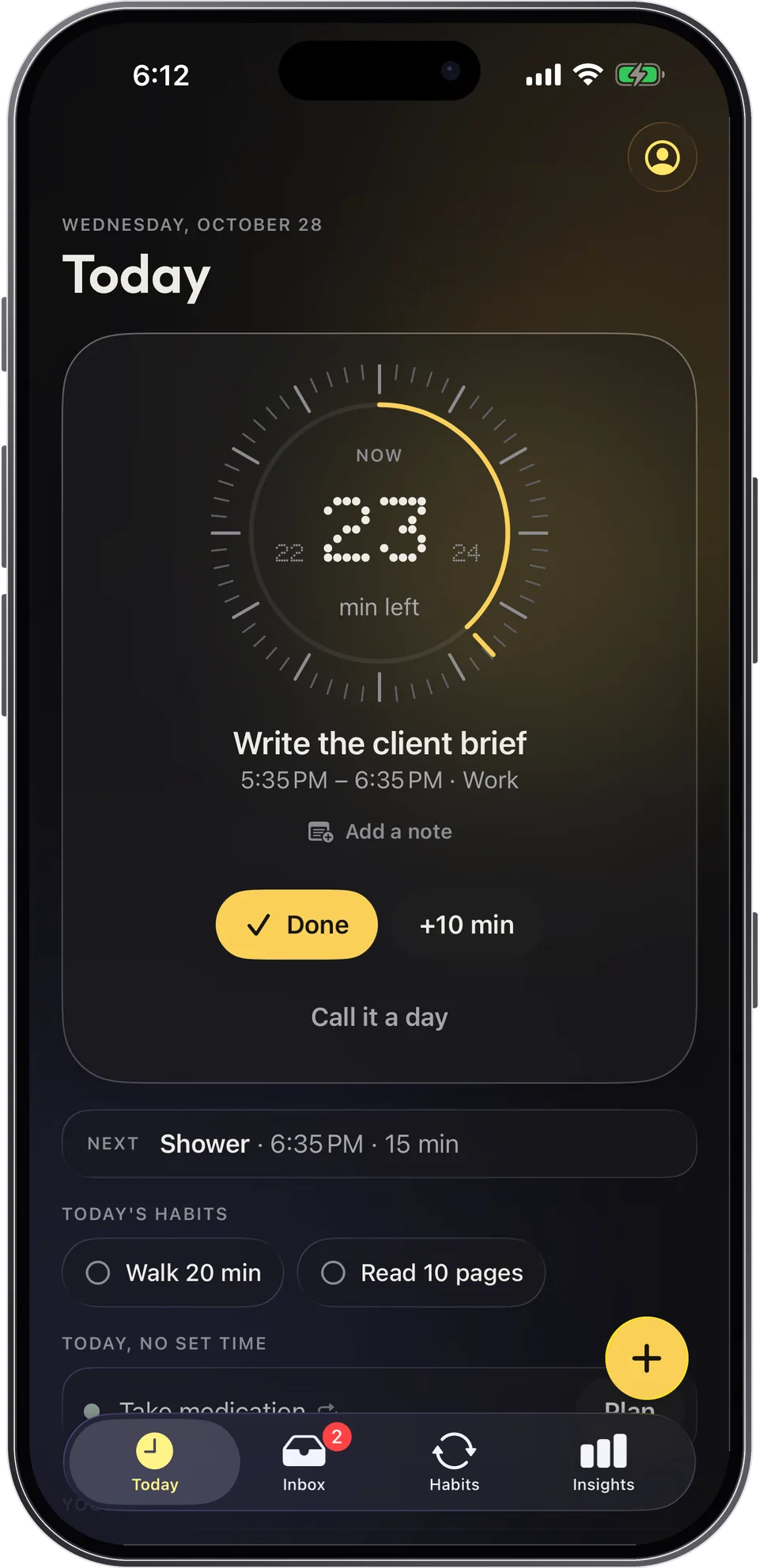
Capday is a visual day planner for iPhone, iPad and Apple Watch, made for anyone who wants to see their day clearly and stop feeling behind. It was built with ADHD and autistic people in mind, but it is for everyone. Your day is a list of time blocks, and the current one sits on a dial that empties as time passes. It is a planning tool, not a medical device.
- Blocks that bend. Drag a block's edge to change its length, add "+10 min" in one tap, and undo any change.
- Now and next. The dial shows the minutes left in the current block, and what comes next is always visible. On Apple Watch, gentle taps arrive before a block ends and when the next one starts.
- Capture now, schedule later. The Inbox lets you jot something down in two seconds and place it in your day later.
- No guilt when the day slips. "Call it a day" moves what's left to tomorrow or the Inbox, and the morning carry-over offers unfinished things without "overdue" language.
- A real fresh start. After more than three days away, or on a Monday or the 1st of the month, your whole backlog can be tidied into the Inbox in one tap.
Frequently asked questions
How long should it take to plan your day?
Five to ten minutes is usually enough. If it takes you half an hour, your plan is probably too detailed. The goal is to know what to do next, not to schedule every minute.
Is it better to plan in the morning or the night before?
The night before lets you start without deciding everything from scratch, and making a plan helps you let go of unfinished tasks 5. Mornings work if you think more clearly then. Pick the moment you'll stick with most often.
Does time blocking work with ADHD?
It can help if you keep blocks generous, add buffers and use something that shows time passing, like a timer or a dial. Difficulties with estimating time are often described in adults with ADHD 3, so plan extra margin and adjust without judging yourself.
What if I never finish my to-do list?
Almost everyone is in the same boat, because we underestimate how long things take 2. Cut the day's list to one to three priorities, treat the rest as a bonus, and move what's left in the evening without treating it as a failure.
Should you schedule breaks?
Yes. Unplanned breaks tend to vanish or stretch out. Put short breaks between blocks and a real meal time in your plan. They are part of the day, not part of the buffer.
Paper or app for planning your day?
The best tool is the one you actually look at. Paper is simple and stays visible on your desk. An app goes everywhere with you, can alert you before a block ends and makes it easier to move what's left to tomorrow.
Sources
- Aeon, B., Faber, A., & Panaccio, A. (2021). Does time management work? A meta-analysis. PLOS ONE, 16(1), e0245066. doi.org
- Buehler, R., Griffin, D., & Ross, M. (1994). Exploring the "planning fallacy": Why people underestimate their task completion times. Journal of Personality and Social Psychology, 67(3), 366–381. doi.org
- Mette, C. (2023). Time perception in adult ADHD: Findings from a decade, a review. International Journal of Environmental Research and Public Health, 20(4), 3098. doi.org
- Gollwitzer, P. M., & Sheeran, P. (2006). Implementation intentions and goal achievement: A meta-analysis of effects and processes. Advances in Experimental Social Psychology, 38, 69–119. doi.org
- Masicampo, E. J., & Baumeister, R. F. (2011). Consider it done! Plan making can eliminate the cognitive effects of unfulfilled goals. Journal of Personality and Social Psychology, 101(4), 667–683. pubmed.ncbi.nlm.nih.gov
- Scullin, M. K., Krueger, M. L., Ballard, H. K., Pruett, N., & Bliwise, D. L. (2018). The effects of bedtime writing on difficulty falling asleep: A polysomnographic study comparing to-do lists and completed activity lists. Journal of Experimental Psychology: General, 147(1), 139–146. pmc.ncbi.nlm.nih.gov
Capday is a planning tool, not a medical device. It does not diagnose anything and is not a substitute for professional advice.