
How to stop procrastinating: what actually works
In short
Procrastination is putting off something you intended to do, even though you expect to be worse off for the delay. It is mostly a way to escape an unpleasant feeling in the moment, not laziness, and it loosens with tiny first steps, if-then plans and kindness toward yourself.
What is procrastination?
Procrastination means putting off something you intended to do, even though you expect the delay to leave you worse off. It isn't the same as resting or choosing priorities. Psychologist Piers Steel calls it a classic form of self-regulation failure: you meant to act, and the gap between intention and action keeps growing.
Steel's 2007 review pooled 691 correlations from research on procrastination 1. It cites estimates that procrastination chronically affects some 15 to 20% of adults, and it is even more widespread among college students 1.
The strongest and most consistent predictors weren't neuroticism or rebelliousness. They were mostly:
- An aversive task. The more boring or difficult a task feels, the more likely people are to delay it 1.
- Low confidence in your ability to succeed at it 1.
- Impulsiveness and distractibility, along with lower self-control and organization 1.
Steel brings these together in temporal motivation theory: a reward that sits far in the future weighs less than a small comfort available right now 1. That's why a deadline three weeks away barely registers, while the same deadline tomorrow suddenly feels urgent.
Is procrastination just laziness?
No. Laziness is not wanting to do something. Procrastination is wanting to do it and avoiding it anyway. Researchers Fuschia Sirois and Timothy Pychyl describe it as short-term mood repair: you put off the task to escape the unpleasant feeling it triggers right now, and your future self pays the price.
In their 2013 review, Sirois and Pychyl argue that procrastination has a great deal to do with managing emotions in the moment 2. A task can stir up boredom, anxiety, self-doubt or the fear of doing it badly. Delaying it brings quick relief. That relief is real, which is exactly why the habit sticks.
The catch is time. The relief arrives now, while the cost lands on a later version of you who still has the task, now with less time and often more stress 2.
This changes what to work on:
- Lecturing yourself rarely helps, because the problem is the feeling, not a lack of values.
- Making the task smaller, clearer or less threatening often helps more than pushing harder.
- Being harsh with yourself adds one more bad feeling to escape, which can keep the cycle going.
“the consequences of procrastination are typically borne by the future self”
Is procrastination a sign of ADHD?
Not on its own: almost everyone procrastinates sometimes. Research does suggest a link with inattention. In one study of university students, those who reported more attention difficulties also procrastinated more. If chronic procrastination comes with lifelong trouble focusing, organizing and keeping track of time, a professional assessment can help you see what's going on.
Niermann and Scheres studied 54 undergraduates with low to high levels of self-reported ADHD-related traits 5. Once the different trait areas were separated, only inattention was linked to general procrastination, with correlations of about 0.4 to 0.5. Hyperactivity and impulsivity were not reliably linked 5.
The authors call this a preliminary finding: the students were not a clinical ADHD group, and almost all of them were women 5. It's a clue, not a conclusion.
If you have ADHD, the ideas in this guide still apply, often with more outside structure: time you can see, a cue that tells you when to start, a plan that lives outside your head. And only a qualified professional can assess ADHD, not an article.
| Technique | Helps most when… | Limit | What the research says |
|---|---|---|---|
| Tiny first step | The task feels huge, vague or unpleasant | Gets you started, doesn't plan the rest | Practical advice: aversive tasks get delayed most 1 |
| If-then plan | You "mean to" do it but never start | Needs a reliable cue in your day | Medium-to-large effect on reaching goals, 94 tests 4 |
| Visible time (timer, blocks) | A distant deadline doesn't feel real | Too tight a time box can add pressure | Practical advice: distant rewards weigh less 1 |
| Removing distractions | You drift to your phone or a tab | Doesn't address the feeling about the task | Distractibility predicts procrastination 1 |
| Self-forgiveness after a slip | Guilt piles up after a lost day | Not a plan on its own | Link seen in one study of students 3 |
| Structured program | Procrastination is chronic and costly | Takes time and access to a professional | Large average reduction across 24 studies 6 |
How do I start a task I keep putting off?
Shrink the first step until it feels almost too easy: open the document, write one sentence, put on your running shoes. Then give it a short, visible time box, like ten minutes on a timer. Starting is often the hardest part, and a tiny, concrete step lowers the discomfort that makes you avoid the task.
Steel's review found that the more aversive a task feels, the more people put it off 1. You can't always make a task enjoyable, but you can make the next step small enough that it stops feeling threatening.
- Name the first physical action. Not "work on the report" but "open the report and reread the last paragraph."
- Set a short time box. Ten or fifteen minutes is a deal your brain can accept. If you want to keep going afterward, good. If not, you still started.
- Make time visible. A timer, a clock or a ring that empties shows how much is left. A vague afternoon feels endless; a 15-minute block has an end.
- Close the easiest exit. Put your phone in another room or close the tab you always drift to. Distractibility is one of the predictors in Steel's review 1.
This is practical advice built on the research, not a formula tested as such. Try it for a week and keep what works for you.
Do if-then plans really help you stop procrastinating?
Yes, they're among the better-studied tools for getting started. An implementation intention links a specific moment to a specific action: "When I finish lunch, I'll open my tax form." A meta-analysis of 94 tests found a medium-to-large effect on reaching goals, including on getting started in the first place.
Psychologists Peter Gollwitzer and Paschal Sheeran reviewed 94 independent tests of implementation intentions and found an effect of d = 0.65 on goal attainment, which they describe as medium to large 4. If-then plans helped people start working toward a goal, stay on track despite distractions and let go of plans that were failing 4.
The trick is that the decision is made in advance. When the moment comes, you don't have to negotiate with yourself: the situation becomes the cue.
To write a good one:
- Pick a reliable cue. A time ("at 9:00") or a moment you never miss ("after coffee").
- Pick a tiny action. Pair it with the first step from the previous section.
- Plan for the obstacle. "If I catch myself opening social media, then I'll turn the phone face down and restart the timer."
Keep in mind that this meta-analysis covers many kinds of goals, not procrastination only 4.
How do I bounce back after a day lost to procrastination?
Forgive yourself, then make tomorrow lighter. In a study of first-year students, those who forgave themselves for procrastinating before a first exam procrastinated less before the next one. Guilt can feel like taking things seriously, but it mostly adds another bad feeling to avoid. Move what's left, pick one small first step and start again.
Wohl, Pychyl and Bennett followed university students across two rounds of midterm exams 3. Students who had forgiven themselves for procrastinating before the first round felt less negative emotion afterward and procrastinated less before the second 38. Self-forgiveness was also linked to better results on the second exams 8.
It was an observational study of students, so it shows a link, not proof that forgiveness causes the change. But it fits the mood-repair view: if a slip triggers shame, the next task feels even heavier 2.
A gentle reset after a lost day:
- Close the day on purpose. Move what's unfinished to tomorrow or to a list, instead of letting it hang over you.
- Notice what got in the way. Too big, too vague, too tired, too many distractions. With curiosity, not as a verdict.
- Choose one thing for tomorrow, with its tiny first step and, ideally, an if-then cue.
- Talk to yourself like you would to a friend. Forgiving yourself isn't letting yourself off the hook. It's what lets you get back to it.
When is procrastination worth getting help for?
When it becomes chronic and starts costing you: missed deadlines, money trouble, poor sleep or constant stress. Procrastination isn't an illness, but it's linked with worse wellbeing over time, and structured programs can help. A doctor or psychologist can help you understand what's behind it, including possible ADHD, anxiety or low mood.
A Swedish study followed 3,525 university students. Nine months later, higher procrastination was associated with more depression, anxiety and stress, more disabling pain in the arms, poorer sleep, loneliness and money difficulties, even after accounting for many other factors 7. The links were modest, and the study shows association, not cause 7.
The good news: procrastination can change. A meta-analysis of 24 intervention studies with 1,173 participants found a large reduction in procrastination after the interventions, and the effects held at follow-up 6. Cognitive behavioral approaches reduced it more than other types of interventions 6.
Consider reaching out if:
- procrastination has been affecting your work, studies or finances for months;
- you feel stuck in shame or low mood most days;
- you've struggled with attention, organization and time since childhood.
How Capday can help
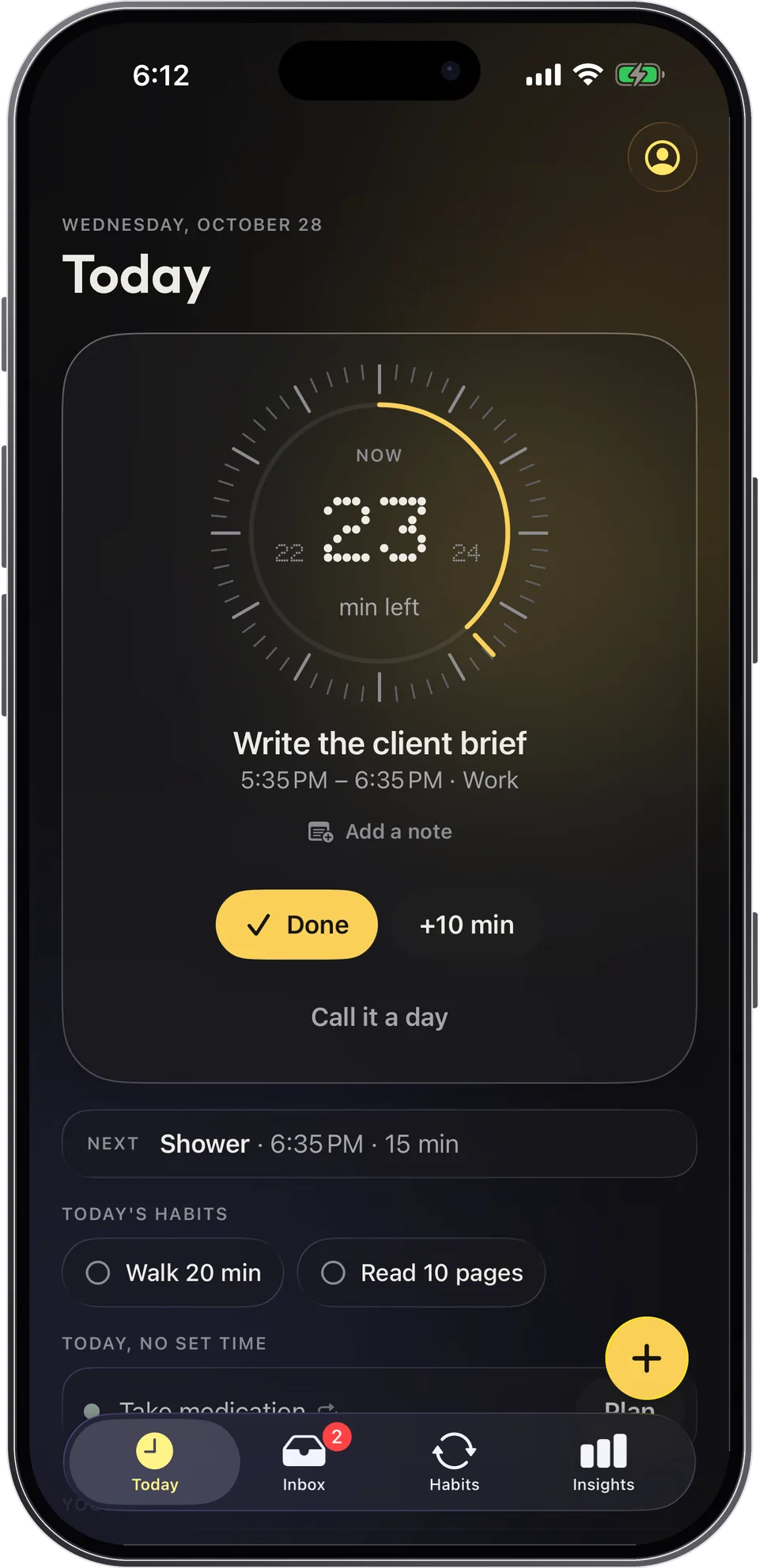
Capday is a visual day planner for iPhone, iPad and Apple Watch. It was built with ADHD and autistic people in mind, for anyone who wants to see their day clearly and stop feeling behind. It is a planning tool, not a medical device.
- Time you can see. The current block sits on a dial that empties as time passes, with the minutes left and what's next always visible. "+10 min" takes one tap.
- A cue to get started. Guided routines go one step at a time, each with its own timer, and a "When?" cue like "After coffee" turns an intention into an if-then plan.
- Capture now, decide later. The Inbox takes a thought in two seconds, so you can schedule it later instead of holding it in your head.
- No guilt when the day slips. "Call it a day" moves what's left to tomorrow or the Inbox, the morning carry-over offers unfinished things without "overdue" language, and after more than 3 days away the whole backlog can be tidied into the Inbox in one tap.
- Habits without a streak that resets to zero. Your consistency over the last 30 days shows as dots, and rest days count.
Frequently asked questions
Don't I work better under pressure?
It can feel that way, because urgency drowns out the discomfort. But Steel's review notes that people who procrastinate tend to perform worse overall 1. Visible time and a tiny first step give you some of that urgency without the last-minute stress.
Why do I procrastinate more when I'm tired or stressed?
When your mood is low, a task feels more unpleasant and the pull toward instant relief gets stronger. That fits the view of procrastination as short-term mood repair 2. On those days, make the step even smaller.
Is procrastination a disorder?
Can an app stop me from procrastinating?
Not for you. An app can make time visible, give you a cue to start and make restarting after a bad day easier. The first step is still yours, and it can be tiny.
Is Capday a medical app?
No. Capday is a planning tool, not a medical device. It is designed to help you see your day and doesn't replace support from a professional.
Sources
- Steel, P. (2007). The nature of procrastination: A meta-analytic and theoretical review of quintessential self-regulatory failure. Psychological Bulletin, 133(1), 65–94. doi.org
- Sirois, F. M., & Pychyl, T. A. (2013). Procrastination and the priority of short-term mood regulation: Consequences for future self. Social and Personality Psychology Compass, 7(2), 115–127. doi.org
- Wohl, M. J. A., Pychyl, T. A., & Bennett, S. H. (2010). I forgive myself, now I can study: How self-forgiveness for procrastinating can reduce future procrastination. Personality and Individual Differences, 48(7), 803–808. doi.org
- Gollwitzer, P. M., & Sheeran, P. (2006). Implementation intentions and goal achievement: A meta-analysis of effects and processes. Advances in Experimental Social Psychology, 38, 69–119. doi.org
- Niermann, H. C. M., & Scheres, A. (2014). The relation between procrastination and symptoms of attention-deficit hyperactivity disorder (ADHD) in undergraduate students. International Journal of Methods in Psychiatric Research, 23(4), 411–421. pmc.ncbi.nlm.nih.gov
- van Eerde, W., & Klingsieck, K. B. (2018). Overcoming procrastination? A meta-analysis of intervention studies. Educational Research Review, 25, 73–85. doi.org
- Johansson, F., Rozental, A., Edlund, K., et al. (2023). Associations between procrastination and subsequent health outcomes among university students in Sweden. JAMA Network Open, 6(1), e2249346. doi.org
- Jarrett, C. (2010). The cure for procrastination? Forgive yourself. British Psychological Society, Research Digest. bps.org.uk
Capday is a planning tool, not a medical device. It does not diagnose anything and is not a substitute for professional advice.