
Time blindness in ADHD: what it is and how to manage it
In short
Time blindness is a popular term for difficulty sensing how much time has passed, how long a task will take, and when it's time to switch. It's widely used in ADHD communities but is not an official DSM-5-TR symptom; research describes related differences in time perception and time management 12.
What is time blindness?
Time blindness describes trouble feeling time pass: ten minutes that turn into an hour, a task you thought would take five minutes, a departure time that sneaks up on you. The phrase is everyday language, not a medical term. You won't find it among the DSM-5-TR criteria for ADHD.
The phrase is mostly used online and in ADHD communities. Researchers use more precise words: time perception (how accurately you judge or reproduce a duration) and time management (how you plan and use your time) 1.
It isn't a formal symptom, but it names something many people with ADHD recognize. And adult ADHD is not rare: a 2021 global meta-analysis estimated that about 2.58% of adults have persistent ADHD that began in childhood, and 6.76% have ADHD symptoms, adjusted to the 2020 world population 5.
Time blindness is not a character flaw or a lack of effort. It's a way of describing the gap between clock time and felt time.
What does research say about ADHD and time perception?
Studies do find timing differences in ADHD, though results vary. A 2022 meta-analysis of 27 studies found that children and teens with ADHD judged durations less accurately and less precisely than their peers 2. A 2023 review of adult studies pointed the same way but called the evidence scarce and mixed 1.
- Children and teens. Zheng and colleagues pooled 27 studies with 1,620 participants with ADHD and 1,249 without. The ADHD groups were less accurate, less precise and more likely to overestimate time. The type of timing task did not explain the gap 2.
- Adults. Christian Mette's review assessed 535 full-text papers from a decade of research and kept 9. Time estimation, time reproduction and time management were the most studied areas; some studies found clear differences, others did not 1.
- Over the long term. Barkley and Fischer followed 131 children with ADHD and 71 comparison children for more than 20 years. As young adults, the ADHD group reproduced shorter durations, with more variable errors on longer intervals, whether or not their ADHD had persisted 3.
- Estimating is not reproducing. Timing is not one single skill. In teens with ADHD, Barkley's team found difficulties reproducing durations but not estimating them 4.
Bottom line: research supports the idea that time feels different for many people with ADHD. But a lab task doesn't measure your day, methods vary a lot between studies, and researchers say more work is needed 1.
“Time perception is impaired in adult ADHD.”
How does time blindness show up day to day?
It often looks like running late despite good intentions, getting absorbed in one thing and missing the next, underestimating how long chores take, or leaving everything until a deadline finally feels close. These are everyday examples, not a checklist, and anyone can have a day like this.
- Now and not now. Time can feel like it has two zones: what's happening right now, and everything else. A meeting in two hours may not feel real until it's ten minutes away.
- Transitions. Stopping one activity to start another is often the hardest part, especially when the current one is absorbing.
- Estimates. “It'll take five minutes” turns into forty, and the day overflows.
- Waiting. Waiting can feel endless, so it's tempting to start something else and lose track.
None of this means you don't care. It means your internal clock isn't a reliable guide. The idea is to move time out of your head and put it where you can see it.
| Strategy | What it does | Tool examples |
|---|---|---|
| Visible countdown timer | Shows time remaining as something you can see shrinking | Kitchen timer, Time Timer, phone timer, Capday dial |
| Analog clock | Shows where you are in the hour at a glance | Wall clock, watch with hands |
| Time blocks | Gives each task a start and an end so the day can't quietly overflow | Paper planner, calendar app, Capday blocks |
| Alerts before transitions | Warns you before you need to stop, not when it's too late | Phone alarms, smart speaker reminders, Apple Watch taps in Capday |
| Buffers | Absorbs underestimates and travel time | 10–15 minutes between commitments, a padded estimate |
| If-then plans | Links a task to a clear cue so starting takes less deciding | Sticky note, written plan, Capday's “When?” cue for routines |
| Tracking real durations | Replaces guesses with your own data | Notebook, stopwatch, notes app |
How can you manage time blindness?
A practical approach is to make time visible instead of relying on how it feels. Use a timer you can see, break the day into blocks, set alerts before transitions, add buffers between commitments, and tie tasks to clear cues. Start with one change and keep what works for you.
- Visible timers. A timer that shows time shrinking (a kitchen timer, a visual countdown, a ring that empties) turns an abstract duration into something you can read at a glance.
- Analog clocks. A clock face shows where you are in the hour. Put one where you work.
- Time blocks. Give each task a start and an end in your day, not just a spot on a list. Blocks make it obvious when the day is full.
- Alerts before transitions. Set an alarm ten minutes before you need to stop, and another when it's time to go. The first one gives you time to wrap up.
- Buffers. Add margin between commitments and to your estimates. If something usually takes longer than you think, plan for the longer version.
- If-then plans. Decide in advance when and where you'll act: “After coffee, I start the email.” Psychologists call these implementation intentions. A meta-analysis of 94 tests found a medium-to-large effect on reaching goals 6. That research was not specific to ADHD.
For one week, write down how long things actually take. You'll build a personal reference that beats any guess.
When should you talk to a professional?
Talk to a doctor or mental health professional if time problems regularly affect your work, studies, relationships or safety, or if you suspect ADHD that has never been assessed. Only a qualified professional can make an ADHD diagnosis. Apps and timers can support daily life but do not replace care.
- You're often late or miss deadlines despite real effort, and it's causing stress.
- Time difficulties come with other long-standing signs, like trouble focusing, staying organized or sitting still.
- You already have an ADHD diagnosis and your current support isn't enough.
- You feel low, anxious or overwhelmed most days.
Bring concrete examples: a week of notes on what ran late and why is more useful than a general impression. Research on time management support for adults with ADHD is still limited 1, so a professional can help you find what fits you.
How Capday can help
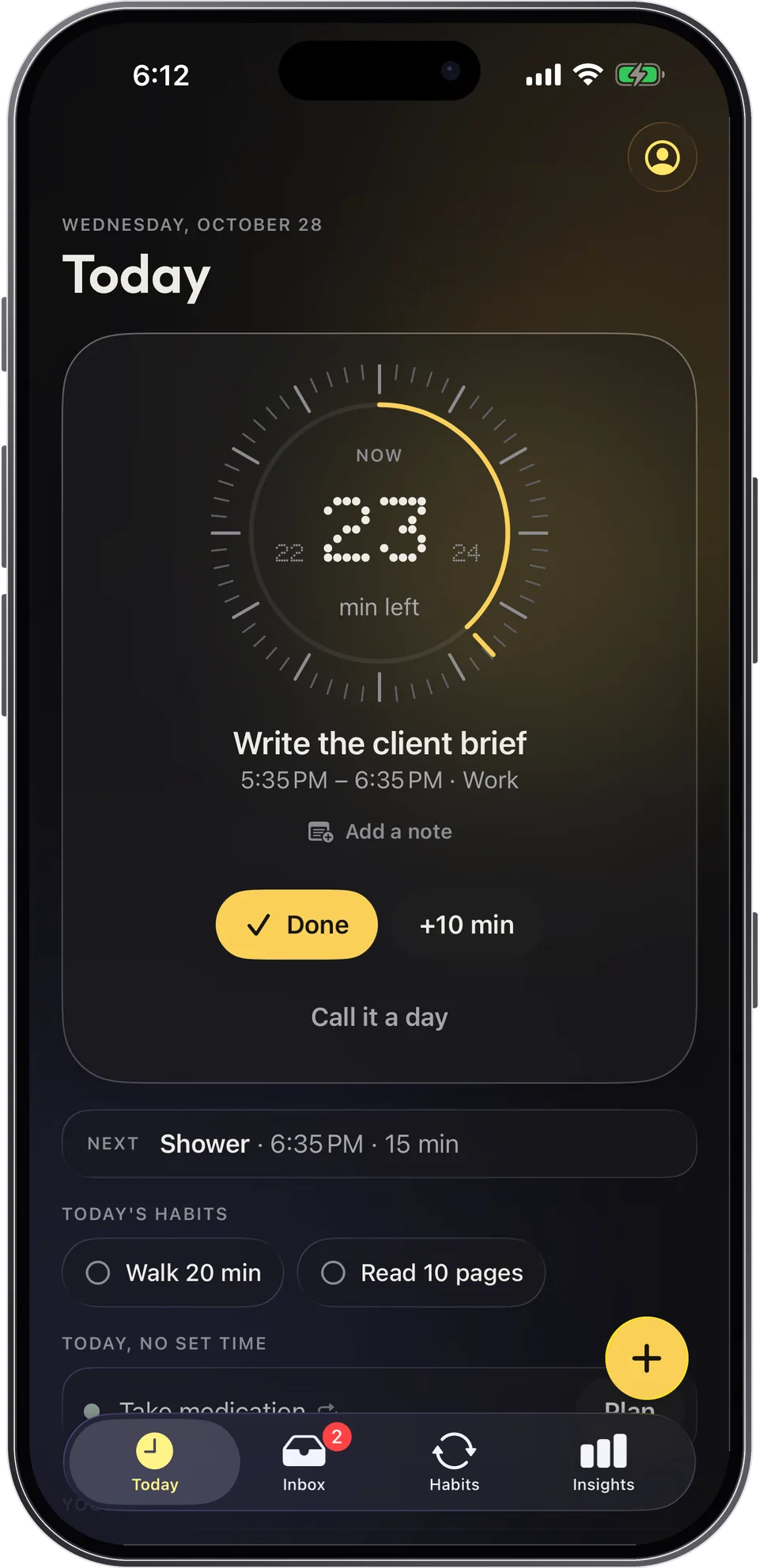
Capday is a visual day planner for iPhone, iPad and Apple Watch, for anyone who wants to see their day, designed with ADHD and autistic people in mind. It's designed to make time visible: your day is a list of time blocks, and the current block is shown on a dial that empties as time passes. It's a planning tool, not a medical device.
- See time pass. The dial shows the minutes left in the current block, and “Next” is always visible.
- Gentle transitions. On Apple Watch, gentle taps let you know before a block ends and when the next one starts.
- Adjust without guilt. Add 10 minutes in one tap, drag a block's edge to change its length, or “Call it a day” to move what's left to tomorrow or the Inbox. Every change can be undone.
- Routines with a cue. Guided routines go one step at a time, each with its own timer, plus a “When?” cue such as “After coffee”.
- Free and private. The free version is complete, with no account, no ads, and data that stays on your device.
Frequently asked questions
Is time blindness a real ADHD symptom?
Do only people with ADHD have time blindness?
No. Anyone can lose track of time, especially when tired, stressed or absorbed. Studies compare groups, so they show average differences, not what every person experiences.
Does time blindness go away with age?
Not necessarily. A follow-up study of more than 20 years found timing differences in young adults who had ADHD as children, even when their ADHD had not persisted 3. What you can change is how visible time is in your day.
What's the best timer for time blindness?
The one you'll actually look at. Visual timers that show time shrinking can be read at a glance. A simple kitchen timer works well too.
Is time blindness the same as procrastination?
No. Procrastination is putting something off. Time blindness describes not sensing time well. They can overlap: if a deadline doesn't feel close, it's easy to postpone it until it suddenly is.
Sources
- Mette, C. (2023). Time Perception in Adult ADHD: Findings from a Decade—A Review. International Journal of Environmental Research and Public Health, 20(4), 3098. doi.org
- Zheng, Q., Wang, X., Chiu, K. Y., & Shum, K. K. (2022). Time Perception Deficits in Children and Adolescents with ADHD: A Meta-analysis. Journal of Attention Disorders, 26(2), 267–281. doi.org
- Barkley, R. A., & Fischer, M. (2019). Time Reproduction Deficits at Young Adult Follow-Up in Childhood ADHD: The Role of Persistence of Disorder and Executive Functioning. Developmental Neuropsychology, 44(1), 50–70. doi.org
- Barkley, R. A., Edwards, G., Laneri, M., Fletcher, K., & Metevia, L. (2001). Executive functioning, temporal discounting, and sense of time in adolescents with attention deficit hyperactivity disorder (ADHD) and oppositional defiant disorder (ODD). Journal of Abnormal Child Psychology, 29(6), 541–556. doi.org
- Song, P., Zha, M., Yang, Q., Zhang, Y., Li, X., & Rudan, I. (2021). The prevalence of adult attention-deficit hyperactivity disorder: A global systematic review and meta-analysis. Journal of Global Health, 11, 04009. doi.org
- Gollwitzer, P. M., & Sheeran, P. (2006). Implementation intentions and goal achievement: A meta-analysis of effects and processes. Advances in Experimental Social Psychology, 38, 69–119. doi.org
Capday is a planning tool, not a medical device. It does not diagnose anything and is not a substitute for professional advice.