
Morning routine: how to build one that actually sticks
In short
A morning routine is a short sequence of steps you do in the same order each morning, each tied to a cue you already have (the alarm, your coffee), so you can start the day without deciding everything. The kind that sticks is short, timed and comes with a lighter version for bad days.
Why does a morning routine actually help?
A routine turns a string of small decisions into a sequence you no longer have to think through. In diary studies, people's minds drifted to other things during habitual actions, and they felt less stress than during non-habitual ones 5. Mornings flow more easily because there is less to decide, right when many people feel slow to get going.
Every morning holds dozens of tiny choices: get up now or in five minutes, shower or coffee first, what to wear, what to eat, what to check on your phone. None of them is hard on its own. Together, they add friction before the day has even started.
Habits work differently. Health psychologists describe them as actions triggered automatically by cues around you, and note that they rely less on conscious attention and motivation 2. In two studies where people logged what they were doing every hour, habitual actions left the mind free to wander, while unfamiliar ones required thinking them through 5.
- Fewer decisions. The order is already set, so you just do the next step.
- Less to remember. When the routine is written down or on a screen, you don't have to hold it in your head.
- A predictable start. You know what comes next, so the first hour feels calmer.
A morning routine is not a productivity contest. It is a way to remove friction so the start of the day costs you less.
How do you build a morning routine that sticks?
Start small: two to four steps you already do or truly want, each tied to a cue you already have, like "after I turn off the alarm" or "after coffee." Write them as if-then plans. A meta-analysis of 94 tests found that this kind of plan had a medium-to-large effect on reaching goals 4.
The secret isn't willpower. It is linking each new step to something that already happens every morning. Psychologists call this an implementation intention: a plan that sets the when, where and how in advance, in the form "If situation Y happens, then I will do X" 4. You may also see it called habit stacking.
- Pick your anchor. The alarm, your feet touching the floor, the kettle, brushing your teeth: something that happens every day without effort.
- Write your if-then. "After I start the coffee, I drink a glass of water." "After I get dressed, I check my plan for the day."
- Keep the same order and place. Habits form by repeating an action in a stable context 2. In the most cited study on the topic, each participant tied their new behavior to a daily cue, such as "after breakfast" 1.
- Add one step at a time. Once a step runs on its own, add the next one.
- Make it visible. A list on the fridge, a note by the mirror or an app that shows one step at a time.
Choose steps that matter to you. A 2024 review found that habits people picked for themselves were generally stronger 3. Copying someone else's routine often feels like homework.
“Habits are also cognitively efficient, because the automation of common actions frees mental resources for other tasks.”
How long does it take for a morning routine to become automatic?
Longer than 21 days, and it varies a lot from person to person. In a study of 96 volunteers, reaching near-peak automaticity took between 18 and 254 days, with a median of 66 days 13. A 2024 review found medians of 59 to 66 days. Expect a couple of months rather than three weeks.
The popular "21 days" figure doesn't come from these studies. In the one by Phillippa Lally and colleagues, 96 volunteers repeated a new eating, drinking or activity behavior every day for 12 weeks, always in the same context 1. Among participants whose data fit the model well, it took a median of 66 days to reach 95% of their automaticity plateau, with a range of 18 to 254 days 13.
A 2024 systematic review brought together 20 studies and 2,601 participants. Only four measured how long habit formation took: medians of 59 to 66 days, and individual times from 4 to 335 days 3.
- Mornings may help. In a stretching study included in that review, the habit took a mean of 106 days to form in the morning, compared with 154 days in the evening 3.
- Early repetitions count most. Automaticity climbs quickly at first, then levels off 3.
- Consistency matters. The more consistently participants performed their behavior, the more clearly a habit curve emerged 1.
If your routine still takes effort after three weeks, nothing is wrong. You are simply in the middle of the curve.
| Version | Typical steps | Good for | Watch out for |
|---|---|---|---|
| Minimal (2–5 min) | Water, get dressed, look at the first task | Bad mornings, travel, low-energy days | Not meant to cover everything: it keeps the anchor alive |
| Short (10–15 min) | 3 or 4 steps tied to existing cues | Getting started, busy weekdays, people who aren't morning people | Easy to let it grow too fast: add one step at a time |
| Standard (25–30 min) | 5 or 6 steps, including some movement or a calm breakfast | Regular schedules with some margin | Needs evening prep to fit; check that it doesn't cut into sleep |
| Long (45–60+ min) | Exercise, journaling, reading, planning | Days without an early commitment, weekends | Hard to keep every weekday: plan a shorter fallback |
How long should a morning routine be?
As long as your real mornings allow, and usually shorter than you think. For most people, 15 to 30 minutes is plenty. Give each step a duration, keep the list short, and protect your sleep rather than setting the alarm earlier to squeeze in a longer routine.
Long "perfect morning" routines rarely survive an ordinary Tuesday. A short routine you do most days beats a long one you do twice. Timing each step helps in two ways: you see whether the whole thing fits, and you know when to move on.
Example: a 15-minute routine
- 2 min: a glass of water and open the curtains
- 6 min: wash and get dressed (clothes laid out the night before)
- 5 min: breakfast or coffee
- 2 min: a quick look at the first things on today's plan
Example: a 30-minute routine
- 3 min: water and daylight
- 5 min: a few stretches or a step outside
- 10 min: shower and get dressed
- 8 min: breakfast
- 4 min: bag, keys and the plan for the day
Adjust the minutes after a week of real mornings. If a step always runs over, give it more time or move it to the evening.
What should you prepare the night before?
Anything that needs a decision: clothes, bag, breakfast and tomorrow's first task. Five minutes in the evening can take several choices off your morning. Above all, protect your sleep: sleep medicine experts recommend that adults sleep 7 or more hours a night on a regular basis 7.
A good morning often starts the evening before. The idea is simple: move decisions to a time when you have a bit more room, so the morning is just doing.
- Lay out your clothes and anything you need to take with you.
- Prepare breakfast, or at least set out the bowl, the mug and the coffee.
- Keep keys, wallet and bag in the same spot by the door.
- Choose tomorrow's first task so you don't have to decide it over coffee.
- Set an evening cue, like a lamp you switch on or a phone charger outside the bedroom.
Waking up earlier is not a goal in itself. The American Academy of Sleep Medicine and the Sleep Research Society recommend 7 or more hours of sleep a night for adults, and link regularly sleeping less to impaired performance and more errors, among other outcomes 7. If your routine only fits by cutting sleep, shorten the routine, not the night.
What should you do on a bad morning?
Switch to a minimal version: two or three essential steps, five minutes at most. Then move on without guilt. In the landmark habit study, missing one opportunity did not materially affect habit formation 1. What matters is coming back to your routine the next day, not keeping a perfect streak.
Bad mornings happen: a short night, a sick kid, a late train, a low day. A routine that only works on good days breaks the first time life gets in the way.
- Plan your minimal version ahead of time. For example: water, get dressed, look at the first task. Decide it on a calm day so you don't have to on a hard one.
- Keep the anchor, drop the extras. The cue stays the same; only the length changes.
- Skip the catch-up. There is no need to do yesterday's steps twice.
- Let go of streaks. Looking at how often you showed up over a month is fairer, and kinder, than a counter that drops to zero.
Research backs this up: missing the occasional opportunity does not seriously impair habit formation 2. A routine is a support, not a test.
Can a morning routine help with ADHD or autism?
It can be a practical support, not medical care. Many autistic people find predictability calming, and intolerance of uncertainty has been linked to anxiety in autistic young people 8. ADHD is often associated with a later body clock 6, so a short, visible routine with timed steps can make mornings feel less chaotic.
The same principles apply to everyone, but a few points matter more for some people.
- Predictability. Knowing exactly what comes next, and in what order, means fewer surprises. For many autistic people, a routine that is the same every day feels like solid ground. A study of autistic children and teens found that intolerance of uncertainty helped explain their anxiety 8.
- Transitions. Mornings often stall between steps. A timer for each step and a heads-up before the next one make the switch less abrupt.
- Body clock. A systematic review of 62 studies found consistent evidence linking ADHD to a later chronotype and delayed sleep onset 6. If mornings are hard for you, that is not a character flaw. A shorter routine, more evening prep and a realistic wake time make a lot of sense.
- Out of your head. A routine on a screen or a wall, rather than in your memory, means you don't have to recall the next step.
These are organizing strategies, not medical advice. If sleep or mornings are a lasting struggle, a doctor or specialist can help.
How Capday can help
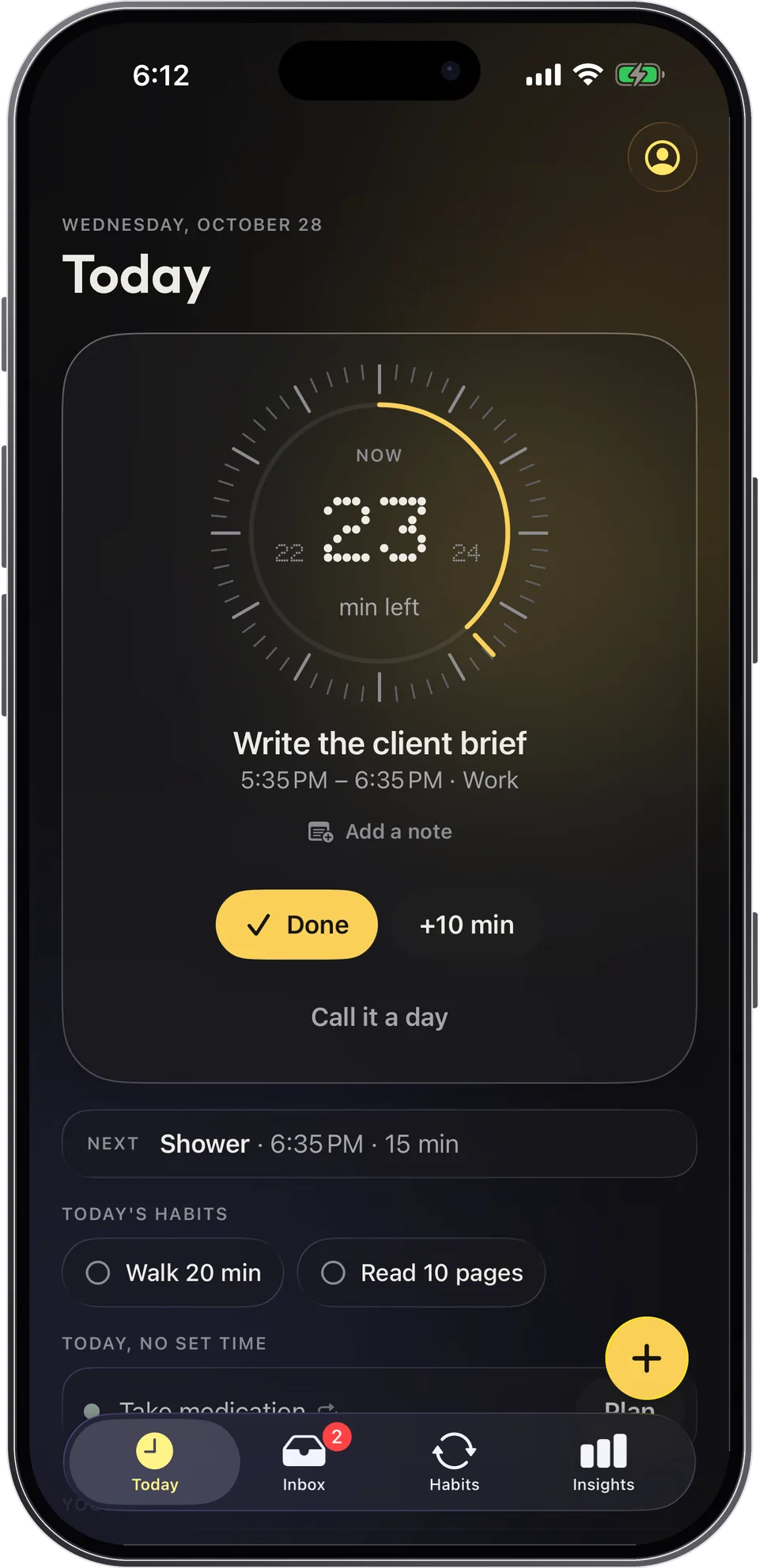
Capday is a visual day planner for iPhone, iPad and Apple Watch, built with ADHD and autistic people in mind and made for anyone who wants a calmer start to the day. Its guided routines turn your morning into one step at a time, each with its own timer. It is a planning tool, not a medical device.
- One step at a time. A guided routine shows the current step and its timer, so you don't have to remember what comes next.
- A built-in cue. Each routine has a "When?" cue, like "After coffee," so your if-then plan is part of the routine itself.
- Ready-made routines. A library of 9 ready-made routines is included, 3 of them free, and you can share a routine by link.
- On your wrist. Apple Watch walks you through a routine step by step, with gentle taps before a block ends and when the next one starts.
- Consistency without streaks. Habits show your last 30 days as dots, rest days count, and there is no streak that resets to zero.
Frequently asked questions
Do I have to wake up at 5 a.m. for a good morning routine?
No. The time matters less than consistency and enough sleep. Adults are advised to sleep 7 or more hours a night 7, so choose a wake time you can keep on most days and build your routine around it.
Does it really take 21 days to build a habit?
What if I skip my routine one day?
Pick it up again the next morning. In Lally's study, missing one opportunity did not materially affect habit formation 1. After a longer break, restart with your minimal version.
Should my routine be the same on weekends?
Keep the anchor and the first steps, and go lighter on the rest. Repeating an action in the same context is what builds a habit 2, so a short weekend version keeps the thread going without turning Saturday into a workday.
Should I avoid my phone first thing in the morning?
There is no single rule. One useful trick: make the first thing you open on your phone your plan for the day, not your messages or a feed. That way your phone tells you what comes next instead of pulling you in.
Can a morning routine replace ADHD care?
No. A routine is an organizing strategy that can make mornings more predictable. It does not replace an assessment or support from a health professional.
Sources
- Lally, P., van Jaarsveld, C. H. M., Potts, H. W. W., & Wardle, J. (2010). How are habits formed: Modelling habit formation in the real world. European Journal of Social Psychology, 40(6), 998–1009. doi.org
- Gardner, B., Lally, P., & Wardle, J. (2012). Making health habitual: the psychology of 'habit-formation' and general practice. British Journal of General Practice, 62(605), 664–666. pmc.ncbi.nlm.nih.gov
- Singh, B., Murphy, A., Maher, C., & Smith, A. E. (2024). Time to form a habit: A systematic review and meta-analysis of health behaviour habit formation and its determinants. Healthcare, 12(23), 2488. doi.org
- Gollwitzer, P. M., & Sheeran, P. (2006). Implementation intentions and goal achievement: A meta-analysis of effects and processes. Advances in Experimental Social Psychology, 38, 69–119. doi.org
- Wood, W., Quinn, J. M., & Kashy, D. A. (2002). Habits in everyday life: Thought, emotion, and action. Journal of Personality and Social Psychology, 83(6), 1281–1297. doi.org
- Coogan, A. N., & McGowan, N. M. (2017). A systematic review of circadian function, chronotype and chronotherapy in attention deficit hyperactivity disorder. ADHD Attention Deficit and Hyperactivity Disorders, 9(3), 129–147. doi.org
- Watson, N. F., Badr, M. S., Belenky, G., et al. (2015). Recommended amount of sleep for a healthy adult: A joint consensus statement of the American Academy of Sleep Medicine and Sleep Research Society. Sleep, 38(6), 843–844. doi.org
- Boulter, C., Freeston, M., South, M., & Rodgers, J. (2014). Intolerance of uncertainty as a framework for understanding anxiety in children and adolescents with autism spectrum disorders. Journal of Autism and Developmental Disorders, 44(6), 1391–1402. doi.org
Capday is a planning tool, not a medical device. It does not diagnose anything and is not a substitute for professional advice.