
Visual schedule for adults: autism and ADHD guide
In short
A visual schedule is a picture of your day: the activities you plan, in order, shown as blocks, images or a timeline, so you can see at a glance what is happening now, what comes next and how much time is left.
What is a visual schedule?
A visual schedule shows your day as a sequence you can see: blocks, pictures, colors or a timeline, in the order things happen. Instead of holding the plan in your head, you glance at it. For adults, it can be a whiteboard, a paper strip, a calendar view or an app built around time blocks.
In autism research, visual schedules belong to a broader family called visual supports. The National Clearinghouse on Autism Evidence and Practice (NCAEP) describes them as concrete cues that give information about an activity, routine or expectation, and names visual schedules, activity schedules, work systems and visual cues among common examples 2.
A good visual schedule answers three questions at a glance:
- What now? The current activity, clearly marked.
- What next? The following activity, so the change doesn't come as a surprise.
- How long? Time made visible, as a block length, a clock or a countdown.
It differs from a to-do list in one key way: a list tells you what to do, a schedule tells you when and in what order. Many people use both.
Why can a visual schedule help autistic and ADHD adults?
A visual schedule moves the plan out of your head and puts it in front of you. The day becomes more predictable, transitions feel less abrupt and there is less to remember. These needs come up often with autism and ADHD, though everyone is different and no single tool suits everyone.
- Predictability. Many autistic people find unexpected changes hard. Seeing the order of the day ahead of time turns a surprise into information you already have.
- Transitions. Stopping one thing to start another is a common friction point. A schedule that shows what comes next, and when, gives you time to get ready instead of being pulled out mid-task.
- Working memory. A meta-analysis of 38 studies found moderate working memory differences between adults with ADHD and adults without it, and concluded that these difficulties persist into adulthood 4. When the plan lives on a screen or a wall, you don't have to keep it in mind.
These are practical reasons, not promises. A visual schedule is an organizing tool. It doesn't replace support from a professional when you need it.
“concrete cues that provide information about an activity, routine, or expectation”
What does the research say, and does it apply to adults?
Visual schedules are among the better-studied supports for autistic people, and several reviews rate them as an evidence-based practice. But most studies involve children and teens, often at school. For adults, the findings are a reasonable extrapolation rather than direct proof, so it helps to know where the evidence stops.
Knight, Sartini and Spriggs reviewed studies published between 1993 and 2013. Of 31 studies on visual activity schedules for people with autism, 16 met their quality criteria. The authors concluded that visual activity schedules can be considered an evidence-based practice, especially when paired with systematic instruction, and noted use from preschool through adulthood 1.
The NCAEP 2020 report reviewed autism research published from 1990 to 2017 and identified 28 evidence-based practices. Visual supports are one of them, backed by 65 studies 2.
The limit is age. NCAEP only included participants from birth to 22, and the oldest age group (19 to 22) appeared in about 5% of studies 2. A separate review of 14 studies found visual activity schedules to be an evidence-based practice for teaching daily living, navigation, vocational and leisure skills to adolescents and adults with intellectual disability 3.
What that means for you: the principle is well supported, but most studies taught specific skills, with an adult's help, in a structured setting. An adult organizing their own day is a different situation. Think of a visual schedule as an experiment worth trying, and keep what works for you.
| Approach | Strengths | Limits |
|---|---|---|
| Paper or whiteboard | Always visible, no screen, easy to change by hand, fully customizable | Stays at home, no reminders or countdown, moving unfinished tasks means rewriting |
| Calendar app | Syncs across devices, great for fixed appointments, easy to share with others | Built for meetings more than for "what now?", empty gaps hide unscheduled tasks, time passing is barely visible |
| To-do list app | Fast capture, good for remembering what needs doing | No sense of when or how long, long lists can overwhelm, "overdue" labels can feel heavy |
| Visual timeline app (like Capday) | Shows now and next with time left, warns you before transitions, moves what's left to tomorrow | Needs your phone or watch at hand, takes a little setup, built for personal rather than shared use |
How do you build a visual schedule as an adult?
Start small: one day, a handful of blocks, a clear "now" and "next." Pick a format you will actually look at, paper or app. Add breaks and transition time, use a few consistent colors or icons, and turn recurring sequences, like your morning, into short step-by-step lists.
- Paper or app. A whiteboard or printed strip is always visible and easy to change by hand. An app goes everywhere with you, can warn you before a change and can move tasks to the next day. Some people combine both: paper at home, phone when out.
- Blocks or a list. Time blocks show duration and help you see whether the day actually fits. A simple ordered list (first, then, next) is lighter and works well if exact times stress you. You can start with order only and add times later.
- Icons and colors. Use a few, consistently: one color for work, one for rest, one for everyday chores, for example. Too many categories and the schedule turns into noise.
- Breaks count. Put rest, meals and recovery on the schedule as real blocks. A day with no breaks on paper still has them, just unplanned.
- Transition warnings. A gentle signal a few minutes before a block ends gives you time to wrap up. A visible countdown can do the same job silently.
- Routines as step lists. Break recurring sequences (morning, leaving the house, bedtime) into small steps shown one at a time. NCAEP also lists task analysis, breaking an activity into small, manageable steps, as an evidence-based practice 2.
How do "after X, I do Y" cues fit in?
An "after X, I do Y" cue is a small plan that links an action to a situation: "after coffee, I check my schedule" or "when I close my laptop, I clear my desk." Psychologists call these implementation intentions. They give a routine a clear starting signal instead of relying on remembering it at the right moment.
Gollwitzer and Sheeran pooled 94 independent tests of these if-then plans and found a medium-to-large effect on goal attainment (d = 0.65) 5. Their analysis suggests the plan makes the chosen situation easier to notice and the response more automatic.
This research mostly involved the general population, not autistic or ADHD adults specifically. The idea still fits naturally into a visual schedule:
- Attach each routine to something that already happens: waking up, coffee, getting home.
- Make the cue concrete and observable: not "in the morning" but "after I brush my teeth."
- Write the cue on the schedule itself, so the trigger and the steps stay together.
What are the most common pitfalls?
The two big ones are planning too much and feeling bad when the day slips. A schedule is a guide, not a contract. Leave buffer time, plan less than you think you can do, and when the day goes sideways, move what's left instead of judging yourself.
- Over-planning. Filling every minute looks productive but leaves no room for transitions, energy dips or surprises. Leave empty space on purpose.
- Too much detail. If updating the schedule takes longer than the tasks themselves, simplify: fewer blocks, broader labels.
- Guilt when the day slips. Days slip for everyone. Moving a block to tomorrow is a normal way to use a schedule, not a failure.
- The restart trap. After a few days away, a pile of overdue items can make it hard to come back. Clear the slate and plan just today.
- One plan for every day. Low-energy days may need a lighter version. A ready-made "minimum day" template helps.
Once a week, look at what worked and adjust. The best schedule is the one you keep looking at.
How Capday can help
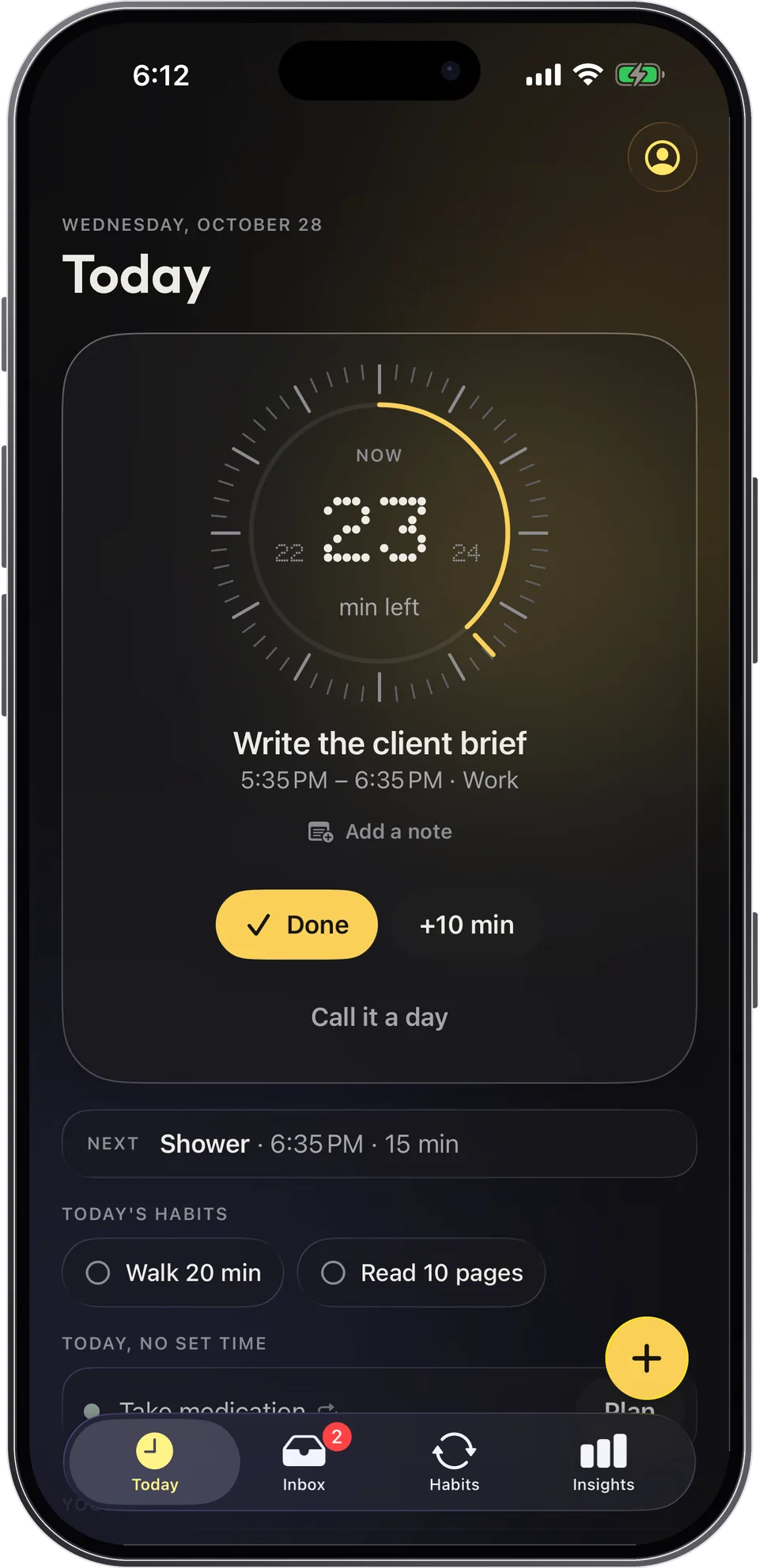
Capday is a visual day planner for iPhone, iPad and Apple Watch, built with ADHD and autistic people in mind and useful to everyone. Your day is a list of time blocks, and the current one sits on a dial that empties as time passes, with the minutes left and what comes next always visible. It is a planning tool, not a medical device.
- Now and next on one screen. The current block shows on a dial with the minutes left, "+10 min" takes one tap, and every change can be undone.
- Gentle transitions. On Apple Watch, soft taps arrive before a block ends and when the next one starts.
- Routines one step at a time. Each step has its own timer, and a "When?" cue lets you set a trigger like "After coffee." A library of 9 ready-made routines is included, 3 of them free.
- No guilt when the day slips. "Call it a day" moves what's left to tomorrow or the Inbox, and the morning carry-over offers unfinished things without "overdue" language.
- Private by design. No account, no ads, no analytics: your data stays on your device. The free version is complete.
Frequently asked questions
Do visual schedules work for adults, or only for kids?
Most studies involve children and teens, but the principle, seeing the order and length of your day, applies at any age. A review of studies with adolescents and adults with intellectual disability points the same way 3. Try it and keep what helps.
Is a visual schedule only for autistic people?
No. It comes from autism research, but anyone who loses track of time, finds transitions hard or forgets the next step can use one, including people with ADHD and anyone who gets distracted easily.
Should I use a paper visual schedule or an app?
Use the one you will actually look at. Paper is simple and visible at home. An app comes with you and can warn you before a transition. Many people combine a wall chart for routines with a phone schedule for the day.
How detailed should my schedule be?
Less than you think. Start with 4 to 6 blocks a day, breaks included. Add detail only where you get stuck, such as a step list for your morning routine.
What if I don't stick to my schedule?
That's normal. Move what's left to tomorrow, notice what got in the way and make the next day lighter. A schedule is there to help you, not to grade you.
Is Capday a medical app?
No. Capday is a planning tool, not a medical device. It is designed to help you see your day and doesn't replace support from a professional.
Sources
- Knight, V., Sartini, E., & Spriggs, A. D. (2015). Evaluating visual activity schedules as evidence-based practice for individuals with autism spectrum disorders. Journal of Autism and Developmental Disorders, 45(1), 157–178. doi.org
- Steinbrenner, J. R., Hume, K., Odom, S. L., et al. (2020). Evidence-based practices for children, youth, and young adults with autism. UNC Frank Porter Graham Child Development Institute, National Clearinghouse on Autism Evidence and Practice Review Team. ncaep.fpg.unc.edu
- Spriggs, A. D., Mims, P. J., van Dijk, W., & Knight, V. F. (2017). Examination of the evidence base for using visual activity schedules with students with intellectual disability. The Journal of Special Education, 51(1), 14–26. doi.org
- Alderson, R. M., Kasper, L. J., Hudec, K. L., & Patros, C. H. (2013). Attention-deficit/hyperactivity disorder (ADHD) and working memory in adults: A meta-analytic review. Neuropsychology, 27(3), 287–302. doi.org
- Gollwitzer, P. M., & Sheeran, P. (2006). Implementation intentions and goal achievement: A meta-analysis of effects and processes. Advances in Experimental Social Psychology, 38, 69–119. doi.org
Capday is a planning tool, not a medical device. It does not diagnose anything and is not a substitute for professional advice.