
How long does it take to form a habit? Not 21 days
In short
Forming a habit usually takes much longer than 21 days: in the landmark study by Lally and colleagues, a daily behavior took a median of 66 days to become automatic, ranging from 18 to 254 days from one person to the next 12. And missing a single day does not reset your progress 1.
How long does it take to form a habit?
There is no single number. In Lally's study, a new daily behavior took a median of 66 days to feel automatic, but some people got there in 18 days while others were projected to need 254. A 2024 review points the same way: think in terms of two months or more, not three weeks.
In 2010, Phillippa Lally and her team at University College London followed 96 volunteers. Each one picked an eating, drinking or activity behavior to do daily in the same context (for example "after breakfast") for 12 weeks. Every day, participants recorded whether they did it and how automatic it felt 1.
What they found: automaticity rises quickly at first, then the curve flattens into a plateau. The time to reach 95% of that plateau ranged from 18 to 254 days, with a median of 66 days 12. It was a small study, though: the curve fit well for only 39 of the 82 participants with usable data 1. Read the number as a ballpark, not a rule.
In 2024, Ben Singh and colleagues pulled together 20 studies on forming health habits, covering 2,601 participants. Only four measured how long it took. Their medians ranged from 59 to 66 days, their means from 106 to 154 days, and individual results from 4 to 335 days 2. The authors note that most of the included studies had a high risk of bias 2.
The takeaway: count in months rather than days, and don't compare yourself to anyone else. The gap between two people is huge, and it depends on the behavior, the setting and the kind of week you're having.
Where does the 21-day habit myth come from?
The number traces back to Psycho-Cybernetics, a book by Maxwell Maltz, not to a study of habit formation. Researchers who actually measured the time found much longer and far more variable durations. A 2024 review concludes that the evidence clearly refutes the popular idea that habits form in roughly 21 days.
Singh and colleagues trace the idea to Maxwell Maltz's book Psycho-Cybernetics, which suggested that new habits could form with just 21 days of repetition 2. The number then spread through challenges and apps much faster than any data did.
Studies that actually timed the process tell a different story. In one study on healthy eating, only 23% of participants reached the threshold set for calling it a habit 2. The review authors draw a practical conclusion: brief 21-day challenges are unlikely to be enough to firmly ingrain a new habit 2.
That doesn't make three weeks pointless. The earliest repetitions bring the biggest gains in automaticity 2. It just means that if the behavior still takes effort on day 22, you haven't failed. That's the normal pace.
“Missing one opportunity to perform the behaviour did not materially affect the habit formation process.”
Does missing a day ruin a habit?
No. In Lally's study, missing one opportunity to perform the behavior did not materially affect habit formation. What matters is consistency over time: participants who did the behavior more consistently tracked the habit curve better. A single gap erases nothing. Just pick up again the next time your cue comes around.
This is one of the most useful findings from the 2010 study, and one of the least known 1. In a paper written for family doctors, Benjamin Gardner, Phillippa Lally and Jane Wardle put it simply: missing the occasional opportunity to perform the behavior did not seriously impair habit formation 3.
Two honest caveats:
- This is about a miss, not weeks off. The study looked at occasional missed opportunities. It also found that participants who did the behavior more consistently tracked the habit curve better 1.
- There's no need to "make up" for it. Nothing in this research suggests doubling up the next day. The simplest move is to return to the usual behavior at the usual moment.
If you have ADHD, shift work or small kids, this matters even more: one day that goes sideways does not wipe out your progress.
| Myth | What research says |
|---|---|
| It takes 21 days to form a habit | A median of 66 days in Lally's study, 59 to 66 days across the four studies that measured it, with individual results from 4 to 335 days 12 |
| Missing a day resets everything | Missing one opportunity did not materially affect habit formation; consistency over time is what counts 13 |
| You have to do it every day | For exercise, four sessions a week for six weeks was enough to establish the habit in new gym members 5 |
| An unbroken streak always motivates | An intact streak encourages you, but a broken one lowers the urge to continue, even with identical behavior 6 |
| You just need motivation | Habits are triggered by cues in your context and can persist after motivation fades 34 |
| More reminders are better | In one intervention, electronic reminders increased repetition but held back automaticity 4 |
Why can habit streaks backfire?
An unbroken streak motivates, but a broken one deflates. Across seven studies, Silverman and Barasch found that people were more likely to repeat a behavior when their log showed an intact rather than a broken streak, even when their actual behavior was identical. The counter becomes a goal in itself, and a reset weighs on what follows.
Their studies covered exercise, language learning and games 6. The key point: the effect did not depend on what people had actually done, only on how their history was shown in the log 6. Two details back this up:
- The broken-streak effect was stronger when people blamed themselves for the break 6.
- It was weaker when they could "repair" the streak by filling in the missed day 6.
The authors even suggest that apps avoid highlighting broken streaks and consider counting by the week rather than by the day 6.
Put that next to Lally's study: a single miss barely affects the habit itself 1, yet a counter back at zero tells you the opposite. The screen shows a loss that hasn't happened in your head. Streaks aren't bad in themselves, and they do encourage you while they last 6. The reset is the problem.
How do you build a habit without streak pressure?
Pick a simple behavior you actually want to do, and attach it to a moment that comes around every day, like "after coffee" or "when I get home." Repeat it in that same context. Track your consistency over several weeks instead of a counter, and when you miss, pick up at the next cue without judging yourself.
In psychology, a habit is an action triggered automatically by cues in your surroundings that have become linked to doing it 3. A lot of daily life already works this way: in a study where people logged what they were doing every hour, about 43% of actions were performed almost daily, usually in the same context 4.
Wendy Wood and Dennis Rünger describe three pillars of habit formation: repetition, a stable context and a suitable reward 4. In practice:
- A stable cue. Pick a time and place you encounter every day, and do the behavior each time you're there 3. "After I brush my teeth" works better than "in the evening."
- Small and simple. Among new gym members, low exercise complexity was one of the factors that strengthened the habit 5.
- Enjoyable and chosen. Enjoying the activity also predicted habit strength 5, and habits people chose for themselves formed more strongly 2.
- Reminders, in moderation. In one intervention cited by Wood and Rünger, electronic reminders increased repetition but held back automaticity 4. A cue built into your routine is still the best trigger.
- Mornings, if they suit you. In one study of daily stretching, morning practice became habitual faster than evening practice 2. It's a single study, so the best time is the one you reliably run into.
Why it's worth the effort: once an action is tied to outside cues, it tends to persist even after motivation fades 3. And under stress, time pressure or distraction, people fall back on their habits 4.
Do you have to do it every day, or is a few times a week enough?
Not necessarily every day. Among new gym members, at least four workouts a week for six weeks was the minimum needed to establish an exercise habit. Frequency helps, but consistency matters more than perfection. A weekly target with planned rest days leaves room for real life, and a rest day you planned is not a miss.
Navin Kaushal and Ryan Rhodes followed 111 new gym members for 12 weeks. At least four workouts a week for six weeks was the minimum needed to establish the habit, and consistency was among the factors that strengthened it most 5. Wood and Rünger cite this result as an example of how much repetition matters 4.
Frequency is still a lever: several studies found that practicing more often speeds up habit formation 2. For a tiny behavior, like drinking a glass of water when you wake up, doing it daily is easy. For exercise, reading or anything heavier, a weekly rhythm is often more realistic.
- Set a weekly target. "Three walks this week" survives a busy Tuesday. "A walk every day" doesn't.
- Plan your rest days. A rest day you chose in advance is part of the plan. Counting it as a miss makes your tracking unfair.
- Look at the trend. Over a month, the useful question is "Do I keep coming back to this?" not "Did I check every box?"
How Capday can help
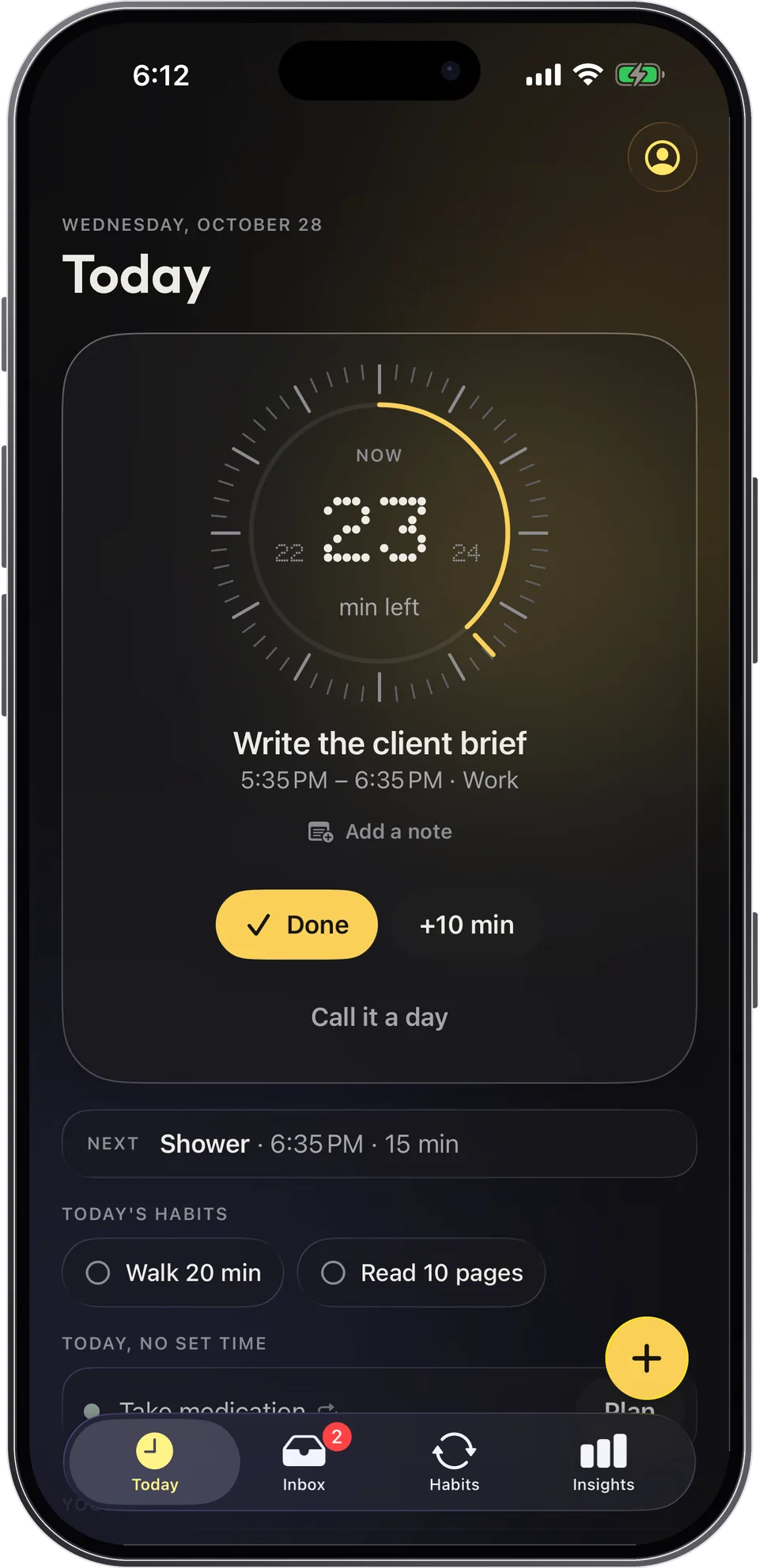
Capday is a visual day planner for iPhone, iPad and Apple Watch. It was built with ADHD and autistic people in mind, but it's for anyone who wants to see their day clearly and stop feeling behind. For habits, it favors consistency over streaks. It is a planning tool, not a medical device.
- No streak that resets to zero. Your habits show as dots over the last 30 days, and rest days count.
- A cue for every routine. The "When?" cue ties a routine to a moment in your day, like "After coffee," and the routine runs one step at a time, each with its own timer.
- Guilt-free restarts. The morning carry-over offers unfinished things without "overdue" language. After more than 3 days away, a fresh start tidies everything into the Inbox in one tap.
- A view of your week. The weekly review (Pro) shows what you did, your active days and your habits, then asks you to pick one thing for next week.
- Private by design. No account, no ads, no analytics: your data stays on your device. The free version is complete.
Frequently asked questions
Is 21 days enough to form a habit?
Rarely. Studies that measured it found medians of 59 to 66 days, with individual results ranging from a few days to almost a year 2. Three weeks can get things moving, but don't worry if the behavior still takes effort after that.
Is 66 days the exact target?
No. It's a median from a small study, not a deadline. Depending on the person, estimates ranged from 18 to 254 days 1. Your behavior, your context and your consistency matter more than the calendar.
What if I miss several days in a row?
Is it better to build a habit in the morning?
Maybe. In one study on daily stretching, morning practice became habitual faster than evening practice 2. But that's a single study. The best time is still the one you reliably run into every day.
Does ADHD change how long it takes to form a habit?
The studies cited here weren't specifically about ADHD, so there's no reliable figure to give. The same levers still help: a concrete cue, a simple behavior and tracking that tolerates harder days. If you work with a professional, it's worth discussing with them.
Sources
- Lally, P., van Jaarsveld, C. H. M., Potts, H. W. W., & Wardle, J. (2010). How are habits formed: Modelling habit formation in the real world. European Journal of Social Psychology, 40(6), 998–1009. doi.org
- Singh, B., Murphy, A., Maher, C., & Smith, A. E. (2024). Time to form a habit: A systematic review and meta-analysis of health behaviour habit formation and its determinants. Healthcare, 12(23), 2488. doi.org
- Gardner, B., Lally, P., & Wardle, J. (2012). Making health habitual: The psychology of 'habit-formation' and general practice. British Journal of General Practice, 62(605), 664–666. pmc.ncbi.nlm.nih.gov
- Wood, W., & Rünger, D. (2016). Psychology of habit. Annual Review of Psychology, 67, 289–314. doi.org
- Kaushal, N., & Rhodes, R. E. (2015). Exercise habit formation in new gym members: A longitudinal study. Journal of Behavioral Medicine, 38(4), 652–663. doi.org
- Silverman, J., & Barasch, A. (2023). On or off track: How (broken) streaks affect consumer decisions. Journal of Consumer Research, 49(6), 1095–1117. doi.org
Capday is a planning tool, not a medical device. It does not diagnose anything and is not a substitute for professional advice.